

OEM SiC Furnace Tube Selection Guide for High Temperature Applications
2026-11-25
High-temperature processing demands more than just a furnace that can take the heat — it demands a tube engineered for the exact thermal, chemical, and structural realities of your process. For SiC applications, choosing the wrong furnace tube can quietly erode yield, contaminate wafers, or force premature replacement. As Semicorex continues to support demanding OEM workflows, the focus shifts to a practical question: what actually separates a reliable SiC furnace tube from a costly compromise? This guide cuts through vendor noise and gets straight to the selection factors that matter most in high-temperature environments.
Why Wall Thickness and Ovality Set the Real Operating Limit
Pressure ratings on paper rarely match what happens in the field. Wall thickness carries most of the load against hoop stress, but any local thin spot turns a uniform stress field into a weak link. Even a small reduction from nominal thickness can move the failure point well ahead of the rated pressure.
Ovality makes the problem less predictable. A pipe that is slightly out of round does not share stress evenly around its circumference. The flatter regions flex more under internal pressure, concentrating bending at the points where curvature changes most. Under cyclic loading, those locations can initiate cracks far below the theoretical burst pressure.
Together, wall thickness and ovality set the true operating envelope. Nominal strength calculations assume a perfectly round, uniformly thick cylinder. Real pipe arrives with tolerances, handling marks, and welding distortion. The practical limit is not one fixed number but a range driven by the worst combination of thin wall and out-of-roundness along the line.
Matching SiC Grades to Peak Temperature and Furnace Atmosphere
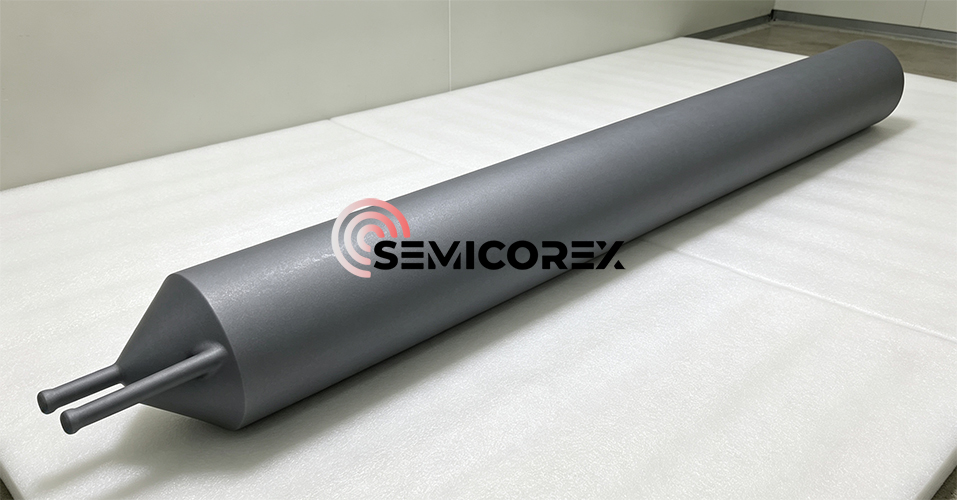
Silicon carbide is not one material with one temperature ceiling. A sintered alpha SiC beam may survive 1650 °C under load in clean air, while a silicon-infiltrated grade starts losing strength above 1350 °C because free silicon softens and bleeds. Recrystallized SiC tolerates very high temperatures, often beyond 1650 °C, but its porous, lower-strength structure suits non-load-bearing furniture better than rotating parts. Matching a grade to peak temperature starts with separating the binder or secondary phase from the SiC grain itself.
Atmosphere then shifts the usable ceiling. In oxidizing conditions, a silica scale forms and can keep sintered SiC stable near its upper limit, but high water vapor or low oxygen partial pressure weakens that scale, so dew point matters as much as temperature. In vacuum or inert gas, silica becomes unstable and bare SiC begins losing silicon to vaporization, leaving carbon-rich surfaces. Nitrogen can react at high temperature to form nitrides and alter the surface, while halogens, sulfur, and alkali vapors attack grain boundaries well below the published maximum.
Practical selection therefore pairs the grade with the exact environment, not the nameplate temperature. A radiant tube in endothermic gas may favor sintered SiC for strength and gas tightness, whereas recrystallized SiC kiln beams work in firing cycles where some porosity is acceptable. Silicon-infiltrated SiC remains a strong choice for wear liners and burner nozzles in moderate-temperature oxidizing service, provided peaks stay below the point where the metallic phase becomes mobile.
Surface Finish Signals That Reveal Hidden Structural Flaws
A dull, slightly rippled band next to a weld rarely gets more than a passing glance, yet that subdued sheen often points to uneven cooling or contamination trapped just below the surface. Running a fingertip across the area, or tilting it under a raking light, can expose micro-tears and laps that a flat, polished finish would otherwise hide. When the surface refuses to take a uniform reflection, it is usually worth checking for incomplete fusion before the part moves further down the line.
On cast and machined components, localized pits, pinholes, or patches that look wet long after cleaning are not random cosmetic blemishes. They frequently sit directly above porosity clusters, entrapped slag, or subsurface shrinkage cavities. A change in gloss across a machined face can also mark a hard spot in the stock, where the cutter briefly rode over a region that resisted material removal differently than the surrounding metal.
Periodic ripples or faint chatter marks deserve attention as well. While they may begin as tooling issues, they sometimes trace back to internal discontinuities, such as an inclusion or a small crack, that alter the stiffness of the part as it passes the cutter. Reading these surface cues early keeps questionable sections from being hidden under paint, powder coat, or anodizing until they fail in service.
Dimensional Tolerances That Keep Hot Zone Alignment Intact
Hot zone alignment lives or dies in the interface details. A molybdenum heating element cradle that sits a few thousandths off its intended plane will shift the entire element array once thermal expansion takes over, pushing the heat pattern toward one side of the workload. The tightest control usually falls on machined bosses, ceramic standoff holes, and the slots that locate graphite posts. These features are dimensioned not just for room-temperature fit, but for the clearance left after the frame grows at operating temperature.
Stack-up is the bigger threat. Individual parts can measure within print and still produce a hot zone that runs eccentric because each small deviation leans the same direction. Shops that get this right often machine mating surfaces in the same setup and call out perpendicularity or parallelism from a single datum rather than relying on isolated hole positions. That keeps the cold assembly centered, so the hot position stays close enough to the furnace centerline to avoid lopsided radiation.
Repeated cycling has a way of punishing tolerances that only worked on paper. Clearances around locating pins and bolted joints need enough room to accept differential growth between graphite, molybdenum, and ceramic, but not so much that the assembly starts to drift after a few dozen runs. A small, controlled amount of radial float at the lower supports, combined with rigid axial registration at the top, often holds alignment through expansion without stressing the brittle components.
Thermal Shock Behavior Beyond the Standard Datasheet Numbers
Datasheet numbers are convenient, but they rarely tell the whole story when a component meets rapid temperature swings in the field. The standard thermal shock figure is usually derived from a controlled lab sequence, often with a fixed ramp rate, dwell time, and transfer speed. Real assemblies, however, experience uneven heating, solder joint fatigue, and board-level mechanical stress that a single pass/fail value cannot capture.
A more useful view comes from tracking behavior beyond the headline number. For instance, repeated exposure to moderate but fast transients can cause microcrack growth in ceramic substrates long before a hard electrical failure appears. Similarly, materials with matched CTE on paper may still delaminate when thermal gradients across the package create localized bending. These failures show up as intermittent opens or drifting leakage currents, not as the abrupt short that a standard test might expect.
Engineers working near the edge of a thermal shock rating should therefore look at what happens between the specified test points. Monitoring resistance shift after each cycle, inspecting for latent cracks under corner bumps, and comparing behavior across different board thicknesses often reveals weak points that the datasheet simply cannot communicate.
Supplier Questions That Separate Dependable OEM Sources
Most sourcing teams wait until a line stops before asking an OEM supplier how they handle a bad batch. The suppliers worth keeping usually welcome tougher questions early: What happens to the deviation record when the root cause is still open at shipment? Can we see the tooling maintenance log for the last six months, not just the certificate? Who in your plant has authority to stop a shipment without a manager's sign-off? The answers reveal whether the quality system is a habit or a folder of templates.
Dependable sources tend to answer with names, dates, and specific parts rather than assurances. Ask a supplier to walk through their last corrective action from containment to verification, and note whether they mention the customer's line rate or only their internal yield. Ask how they trace a material lot after a sub-supplier substitution. Ask what they quietly stopped shipping last quarter and why. If the response gets vague or defensive, that is more useful than a perfect scorecard.
FAQ
Confirm the actual peak temperature, process atmosphere, and whether the tube will run steady-state or see frequent thermal cycles. These factors influence wall thickness, purity, and whether a sintered alpha SiC grade or a CVD-coated tube makes more sense. Also check the heated length, end transition design, and sealing method because custom tubes tend to fail at the cold ends rather than in the hot zone.
Thicker walls add mechanical stiffness and provide more material as an oxidation allowance, but they also create larger temperature gradients during heating and cooling. If the process cycles rapidly, a thinner wall may survive better when support spacing is reduced and the atmosphere is controlled. The real challenge is balancing high-temperature strength against the stress caused by uneven expansion.
They can be if the furnace operates for long campaigns with moisture or aggressive gases. The coating seals surface porosity and slows oxidation, which helps preserve strength over time. However, if the tube experiences frequent thermal cycling, differences in expansion can cause microcracking near the ends. Ask for cyclic oxidation data instead of relying only on isothermal test results.
Sintered alpha SiC usually keeps its strength to higher temperatures and has lower open porosity, which is better for clean processes. Reaction-bonded SiC is often easier to machine into complex shapes and can be cheaper, but residual free silicon limits its upper temperature range. The decision depends on peak temperature, atmosphere, and whether silicon contamination is a concern.
Do not just copy the nominal dimensions from the old tube. Measure the actual heated zone, the transition sections at both ends, and the condition of the sealing surfaces. Allow for thermal expansion and clearance for boats or carriers. For custom work, send a dimensional envelope with tolerance details rather than only a single ID and length.
Ground sealing faces with compliant graphite or ceramic fiber gaskets are common, but they need controlled compression. Water-cooled O-ring seals should be placed far enough from the hot zone to stay within their temperature rating. For higher purity applications, tapered SiC or fused quartz end caps often work better. The goal is a gradual temperature drop so byproducts do not condense in the seal area.
Fine and uniform grain structures reduce particle generation and improve mechanical consistency. High-purity grades limit metallic impurities that can volatilize and contaminate sensitive parts. In these processes the tube is not just a chamber wall, it becomes part of the process atmosphere and can directly affect yield.
A capable supplier should ask for the complete thermal profile, gas composition, operating pressure or vacuum level, heating and cooling rates, support spacing, and any previous failure modes. If the conversation only covers diameter and length, the quote is likely for a commodity part rather than an engineered high-temperature tube.
Conclusion
Wall thickness and ovality usually determine how much stress a silicon carbide furnace tube can absorb before a crack starts, which makes them more revealing than any maximum temperature claim. Even slight eccentricity can create a weak side that fails under normal thermal expansion or minor fixture misalignment. Matching the SiC grade to the furnace atmosphere is just as critical because oxidation, reduction, and high vacuum each attack the material differently, so a grade rated for one environment may lose strength rapidly in another. Surface finish also deserves close inspection; spiral marks, glaze breaks, or shallow pitting often point to uneven sintering or hidden porosity that will not appear in a room-temperature pressure test. Dimensional tolerances around the hot zone and end seals keep heating elements, workpieces, and gas flow aligned, preventing localized overheating and premature tube wear.
Thermal shock behavior is rarely captured by the standard datasheet because rapid cycling in production involves non-uniform loads, varying gas flows, and repeated small temperature swings. A tube that passes a laboratory quench test can still fracture after weeks of routine operation if micro-damage from handling or machining goes undetected. For OEM selection, suppliers should be able to explain how their material performs under ramp rates close to the intended process, not just quote a single thermal shock parameter. It is worth asking for inspection records, lot traceability, and rejection criteria rather than relying on polished specification sheets. Dependable sources usually share dimensional data, surface inspection methods, and examples of tubes that have survived similar service conditions. The most practical choice balances geometry, grade, surface quality, tolerance control, and proven cycling behavior instead of chasing the highest temperature rating.
Contact Us
Contact Person: Svenja Wei
Email: [email protected]
Tel/WhatsApp: +8613567891907
Website: https://www.semicorex.com