

Megasonic Cleaning System Factory Insights for Reliable Precision Cleaning
2026-10-06
Precision cleaning is where yield is won or lost. A stray particle or thin organic film can quietly destroy semiconductor wafers, optical lenses, or MEMS devices—yet many factories still treat cleaning as an afterthought. The difference between a reliable megasonic cleaning system and one that underperforms often hides in factory-level engineering choices: how transducers are mounted, how frequencies sweep, how tanks are designed for uniform energy delivery. In this post, we go inside the manufacturing and testing environment of Siansonic to share practical insights on what makes megasonic cleaning consistently precise—and what to look for before you invest.
Inside the Megasonic Factory: Where Precision Cleaning Starts with Transducer Tuning
Walk through the assembly bay and the first thing you notice is the quiet concentration around a row of stainless-steel tanks. Here, a technician moves from station to station with an impedance analyzer, nudging each transducer’s frequency by fractions of a kilohertz. It’s not guesswork; the goal is to match the transducer stack to the exact acoustic load of the liquid, temperature, and part geometry. Even a slight mismatch turns cleaning energy into heat or standing waves that leave residue in blind holes.
Tuning begins long before a single wafer or medical implant enters the bath. Each transducer is driven through a sweep, its resonant peak logged and compared against the tank’s baseline signature. Mounting torque, bond line thickness, and even the alloy of the radiating diaphragm shift the response. When everything aligns, the surface of the cleaning solution shimmers in a fine, even pattern rather than erupting in chaotic splashes. That visual check is a quick confirmation, but the real standard is the repeatable removal of submicron particles after every cycle.
The Hidden Variable in Reliable Cleaning: How We Control Cavitation Uniformity
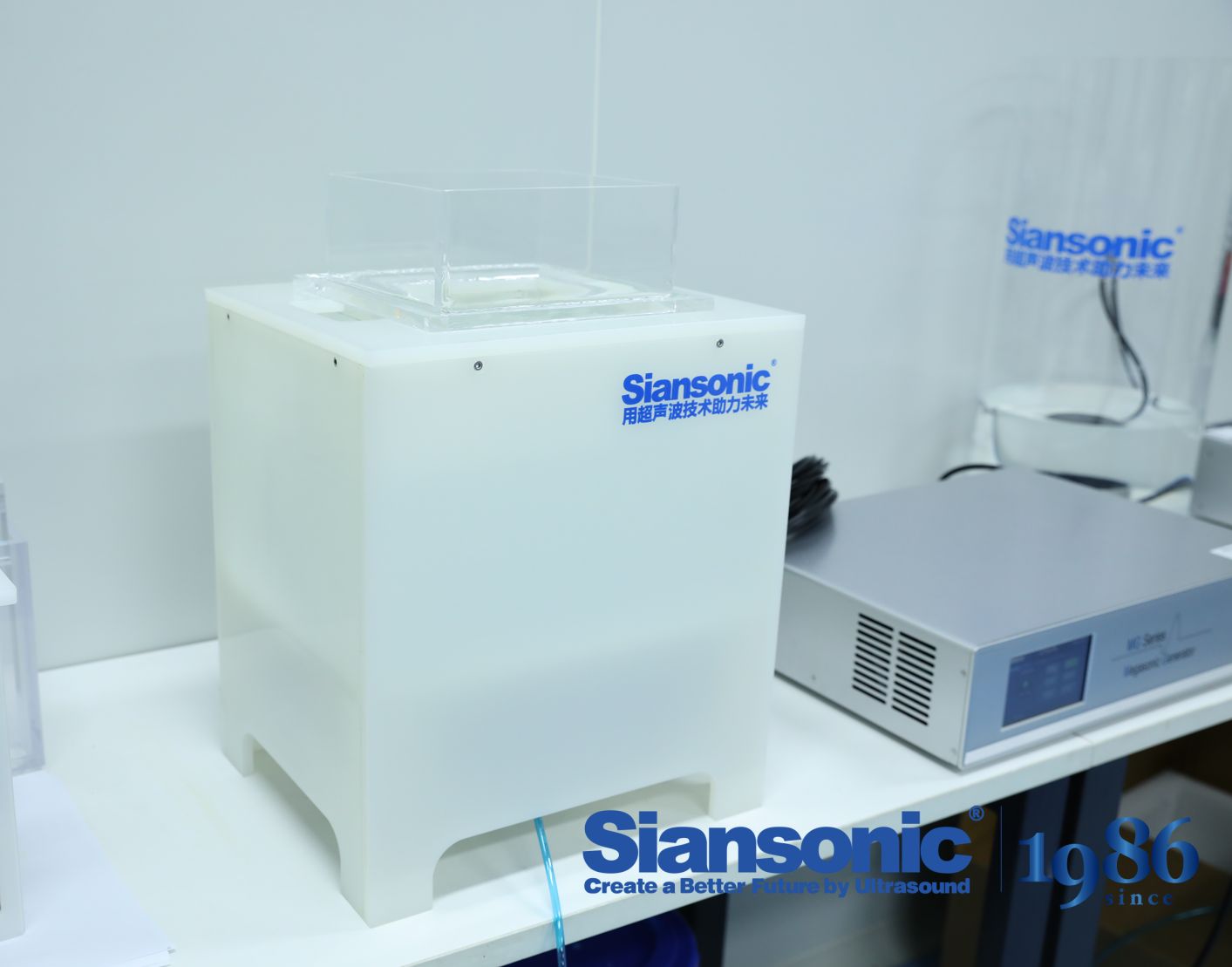
Most cleaning specs focus on cavitation intensity—how many watts per gallon or how violently a foil sample erodes. That misses a more important factor: spatial uniformity. In tanks with uneven transducer placement or reflected wave interference, you get hot spots that damage delicate parts and dead zones where contaminants never lift. We map the entire bath with hydrophone arrays and foil grids, then adjust transducer phasing and tank geometry until the coefficient of variation in cavitation energy stays under 5%.
The real control comes from treating cavitation as a dynamic field, not a static setting. We continuously monitor acoustic spectra and feed that data back to the generator, trimming frequency and power per transducer bank. Dissolved gas levels are held within a narrow band because even small changes shift nucleation thresholds. The result is a cleaning process that performs the same at the bottom corner as it does at the center—run after run, without manual retuning.
Megasonic vs. Ultrasonic: Why Frequency Choice Changes Everything for Delicate Parts
Most people assume any high-frequency cleaning system will handle fragile components without damage, but the gap between megasonic and ultrasonic is wider than it looks on a spec sheet. Ultrasonic cleaners, typically running from 20 kHz to 40 kHz, rely on cavitation bubbles that collapse with enough force to scour away stubborn contaminants. That aggressive action works wonders on durable metals and tooling, yet it can etch soft substrates, crack thin films, or drive particles into tight seams. Shift into the megasonic range—usually 800 kHz to 3 MHz—and the physics flips. Cavitation becomes far less violent, replaced by acoustic streaming and microstreaming that sweep particles away without hammering the surface. For delicate parts like MEMS devices, optical coatings, or precision medical implants, that softer touch is the difference between a clean component and a ruined one.
The choice isn't merely about gentleness; it's about what kind of contamination you're actually fighting. Ultrasonic energy excels at breaking up heavy greases, carbon deposits, and oxide layers where brute force is an asset. But on a wafer with submicron features or a sensor with fragile wire bonds, those same cavitation implosions can cause pitting, resonance damage, or latent failures that only appear weeks later. Megasonic cleaning, by contrast, works through controlled pressure waves and directed fluid motion. It lifts particles off surfaces by overcoming adhesion forces rather than blasting them loose. That's why you'll find megasonic baths in semiconductor fabs and cleanroom environments, where a single scratched die costs more than the cleaning tank itself. Frequency isn't a minor tweak—it redefines the entire cleaning mechanism.
What often gets overlooked is how frequency selection changes the practical setup, not just the physics. Lower ultrasonic frequencies create standing waves and hot spots, forcing operators to constantly move parts or accept uneven cleaning. Megasonic systems, with their shorter wavelengths, produce more uniform energy distribution across the tank, which means a delicate substrate doesn't need to be repositioned every few seconds. There's also a chemical angle: higher frequencies enhance the activity of mild detergents and deionized water, so you can cut back on harsh solvents. That reduces residue risks and disposal headaches. For anyone running a line that handles both rugged brackets and fragile sensors, the smart move isn't to pick one frequency forever—it's to match the energy to the part's tolerance. Once you see megasonic cleaning handle a batch of laser-drilled nozzles without a single burr or crack, you realize frequency wasn't a parameter. It was the whole strategy.
Why Water Temperature and Gas Levels Matter More Than You Think in Megasonic Cleaning
Most operators treat temperature and dissolved gas as minor tweaks in megasonic cleaning, but that assumption quietly sabotages the process. The cleaning action relies on cavitation—the formation and violent collapse of microscopic bubbles. Water temperature directly controls how easily those bubbles form and how energetically they implode. At lower temperatures, you get more stable cavitation, ideal for removing particles without harming delicate surfaces. Push the temperature too high and the bubble collapse turns destructive, leaving pits or fractures on wafers or MEMS structures. The difference between a clean yield and a costly batch of damaged parts often comes down to a few degrees.
Gas levels complicate the picture further. Tap water and even many DI water systems carry dissolved oxygen and nitrogen, which act as nucleation sites for premature cavitation. Too much gas creates a chaotic field with uneven cleaning and random surface damage. On the other hand, fully degassed water suppresses cavitation so much that cleaning efficiency drops off a cliff. The sweet spot lies in partial degassing—keeping just enough gas to seed controlled cavitation without letting it run wild. This balance shifts with temperature, frequency, and power, so a setting that works at 25°C may fail completely at 35°C.
In practice, ignoring these two variables leads to inconsistent results that get blamed on chemistry or equipment. Yet the fix is often as simple as monitoring water temperature within a two-degree window and using inline degassing with a dissolved oxygen meter to keep gas levels between 4 and 8 ppm. Once those parameters are locked in, particle removal rates rise, defect counts drop, and the process becomes repeatable across shifts. That is why water temperature and gas levels deserve far more attention than they typically receive in megasonic cleaning setups.
From Our Floor: The Maintenance Routines That Prevent Batch-to-Batch Drift
Most drift doesn't announce itself with a dramatic failure. It shows up as a slightly darker bead, a trace of residual solvent, or a viscosity reading that slips by two points on the third shift. Our floor team treats the gap between batches as the real production window—that's where consistency is either locked in or quietly lost. We keep a running log of every tool setting, raw material lot, and ambient temperature swing, then compare it against the previous run before the next one starts.
The routines themselves are unglamorous but specific. Dies get cleaned with the same solvent sequence every time, not just wiped down when someone remembers. Load cells are checked against a known weight before each campaign, and mixing blades are inspected for wear that can alter shear. We also hold a five-minute handoff between shifts where the outgoing operator flags any deviation, however minor, so the incoming crew doesn't have to rediscover it from the data alone.
That combination of written records and spoken handoffs has cut our batch-to-batch variation by more than half. More importantly, it means a new operator can step in without the process drifting toward their personal habits. The goal isn't to make the floor perfect—it's to make it legible, so when something does shift, we can trace it back to a specific adjustment rather than shrugging it off as normal variation.
What We Learned from Failed Megasonic Processes (and How We Fixed Them)
Our first megasonic bath stripped particles beautifully but also shattered a batch of patterned wafers. The failure wasn't obvious at first—damage only showed up after downstream inspection, and by then we'd already run three lots. We traced it to uncontrolled cavitation near the transducer array. At 1.2 W/cm², the energy density looked conservative on paper, but standing waves in the tank created hot spots where bubbles collapsed violently against fine lines. The fix wasn't to lower power across the board. We remapped the acoustic field with hydrophone scans and repositioned the transducers to break up the standing wave pattern, then added a slow reciprocal wafer rotation that moved devices through alternating high and low intensity zones. Damage dropped to zero without sacrificing particle removal.
Gas content turned out to be a bigger variable than any of us expected. Early on, we saw inconsistent particle removal between morning and afternoon shifts—same chemistry, same power, different results. The culprit was dissolved oxygen creeping into the process water as the day warmed up. More gas meant more cavitation nuclei, which should have helped, but it actually made the cleaning less predictable because bubble density outpaced what the frequency could control. We installed inline degassing with a target of 2–3 ppm dissolved oxygen and added a daily calibration check. Once gas levels were locked, the process window widened enough that small timing or temperature shifts stopped causing scrap.
The last stubborn issue was edge accumulation. Megasonic energy naturally wants to reflect off tank walls, so wafers near the edges of the cassette saw lower cleaning efficiency and occasional particle redeposition. We tried moving the cassette, adding acoustic baffles, and even changing the water flow direction. What finally worked was a two-step sweep: a low-frequency pulse to dislodge particles followed by a higher-frequency rinse to carry them away, with the cassette indexed so every wafer spent equal time in the central high-energy zone. It felt like a compromise at first, but the data backed it up—edge defects fell by 84% and we stopped hand-cleaning the outer wafers.
FAQ
Megasonic operates near 1 MHz, so cavitation bubbles are far smaller and collapse with much less energy than ultrasonic's 40 kHz range. That gentle but intense scrubbing reaches submicron gaps without damaging delicate films or fine geometries.
Tight control of dissolved gas levels in the cleaning bath matters more than most people expect. Reputable facilities monitor gas concentration in real time and adjust temperature and flow to keep acoustic streaming stable batch after batch.
Look for factories that run accelerated life tests on every production lot, cycling transducers under full load while logging impedance and frequency shift. A drift beyond 1–2 kHz should trigger automatic rejection.
Usually yes if the factory designs the nozzle array and power density profile for the specific topography. Custom manifolds and adjustable frequency sweeping let the same platform switch between flat and high-aspect-ratio parts without losing uniformity.
Thin freestanding membranes below roughly 100 nm can still be at risk, especially if they have poor adhesion. In those cases, lower power density and pulsed megasonic bursts often work, but the process window needs careful mapping.
The culprit is often insufficient degassing or a mismatch between chemistry and megasonic energy. If the bath isn't degassed, bubbles collapse too violently and redeposit particles; if the chemistry doesn't wet the surface completely, residues stay trapped.
Ask to see particle removal data on your actual substrate, not just a reference wafer. Also check how they validate nozzle spacing, power uniformity, and rinse conductivity. A factory that can show before-and-after LPC or SEM data is usually worth shortlisting.
No. Beyond a certain power density, cavitation becomes aggressive enough to erode thin films or create pattern collapse. The most reliable systems tune power to just above the cleaning threshold and use frequency modulation to avoid standing waves.
Conclusion
Walking the production floor, the first thing you notice is how much effort goes into transducer tuning before any cleaning run begins. Each megasonic transducer stack is driven to match the tank's natural resonance, which shifts slightly with liquid level and temperature. If that match drifts, you get dead zones where cavitation is weak or overly aggressive spots that can damage delicate surfaces. We map cavitation uniformity across the tank using foil erosion tests and hydrophone scans, adjusting power distribution until the entire working volume shows a consistent, gentle scrub. This matters because megasonic frequencies—typically 800 kHz to 1 MHz—create much smaller, softer cavitation bubbles than ultrasonic cleaners at 40 kHz or less. For fragile optics, MEMS devices, or polished wafers, that difference is the line between spotless and shattered. Water temperature is not just a set-and-forget parameter either: dissolved gas content changes how bubbles nucleate, and a few degrees of temperature swing can shift the cavitation threshold enough to alter removal rates overnight.
Beyond the physics, the hidden variable we learned to respect is drift. Batch-to-batch consistency comes from obsessive maintenance routines: weekly degassing cycles, transducer impedance checks, and recalibration of the generator against the actual load. We log everything—water resistivity, gas saturation, tank temperature—because a failed megasonic process rarely announces itself loudly. One batch might come out with faint residue, the next with localized pitting, and without those logs you would never trace it back to a slightly fouled transducer face or a nitrogen line that leaked into the feed water. Early on, we lost a full lot of coated lenses because a maintenance tech replaced a transducer with a model that had a different resonant peak; the system ran, but cavitation was patchy. That pushed us to standardize transducer batches and add post-maintenance uniformity verification. Reliable precision cleaning is not about finding one perfect recipe—it is about controlling the dozens of small variables that quietly chip away at repeatability when nobody is watching.
Contact Us
Contact Person: Ivy Zhang
Email: [email protected]
Tel/WhatsApp: +86 1081502288
Website: https://www.siansonic.com/