
China Socks Manufacturer Essentials for Quality and Customization
2026-08-18
Finding a reliable socks manufacturer in China can feel like searching for a needle in a haystack. Whether you're launching a new brand or scaling an existing line, quality and customization aren't just nice-to-haves—they're the backbone of your business. That's where KINDWAY comes in. With years of expertise and a commitment to detail, KINDWAY turns your sock ideas into ready-to-wear reality. Let's explore what truly matters when choosing a manufacturing partner.
Why Sock Longevity Starts with the First Spool of Yarn
Most people judge a sock by its softness or stretch, but the real story of durability is already written in the yarn before the first loop is ever formed. Short, uneven fibers tend to slip and break under daily friction, leading to thin spots and pilling. Long-staple fibers, on the other hand, twist together into a tighter, smoother strand that resists abrasion far longer.
The spinning process matters just as much as the fiber itself. A tightly twisted yarn holds its shape and fights off the constant rub of shoe linings, yet too much twist can make the fabric feel stiff and unforgiving. Skilled mills dial in the exact twist level that balances toughness with the kind of softness your feet actually notice.
Even the most carefully spun yarn won't last without the right blend. Pure cotton feels great but gives out quickly under heel strike and toe drag. Adding a small percentage of nylon or polyester, distributed evenly at the fiber blending stage, creates a reinforcing network that prevents holes without changing the sock's natural feel.
The Knitting Gauges That Separate Premium Socks from Basics
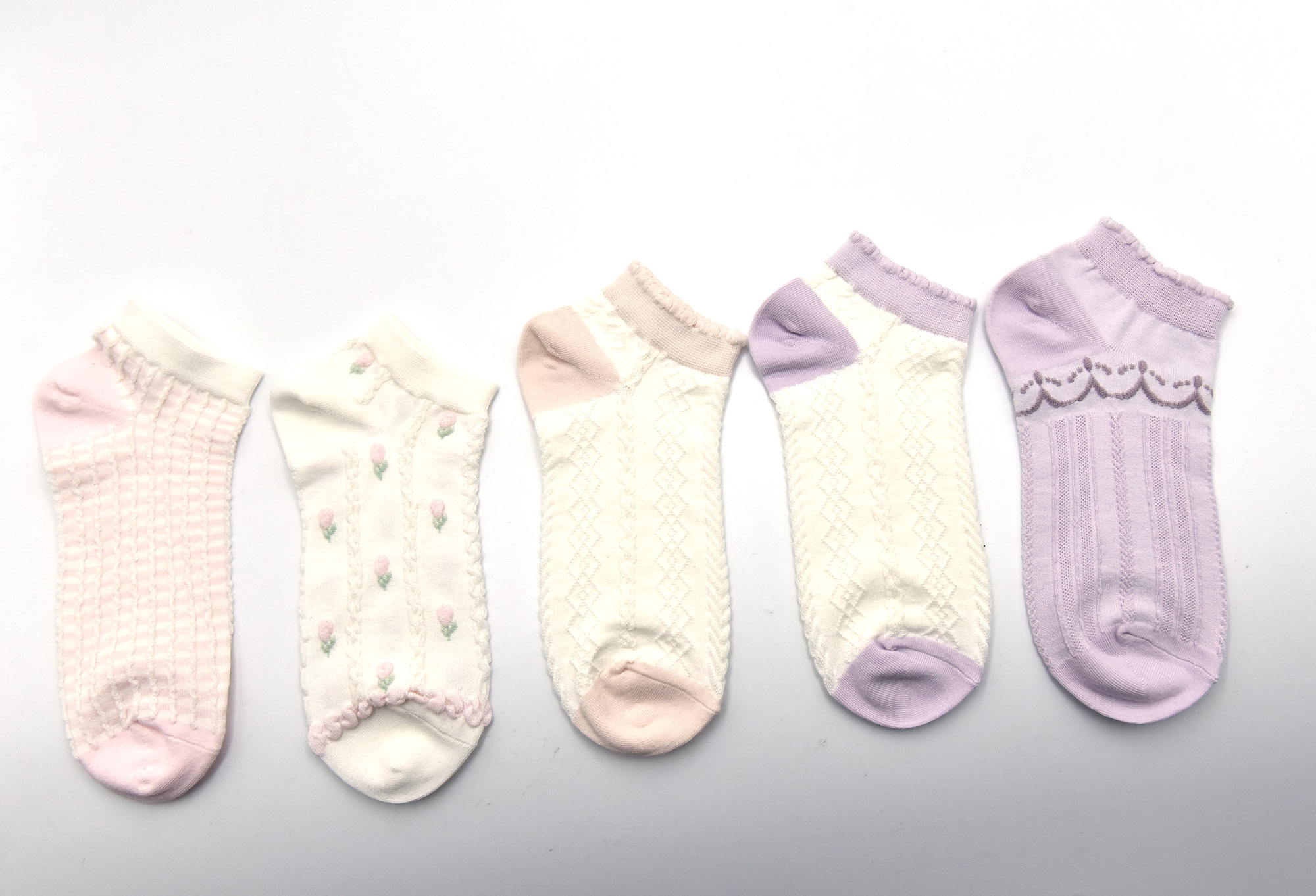
The number of stitches packed into every inch of fabric quietly dictates whether a sock feels like an afterthought or an intentional piece of craftsmanship. Higher knitting gauges mean finer yarns and more loops per inch, producing a denser, smoother surface that glides against the skin. Cheaper basics often settle for a loose, low-gauge knit that saves time and material but leaves a coarser texture prone to pilling and premature wear. Premium socks lean into tighter gauges—sometimes exceeding 200 needles—so the fabric becomes almost silky, hugging the foot without bunching or slipping. That difference is rarely printed on the label, yet it’s the first thing your feet notice when you pull the sock on.
A low-gauge sock might look acceptable on a shelf, but the gaps between stitches invite friction, moisture buildup, and rapid thinning at the heel and toe. As the yarn flexes, those loose loops rub against each other, generating the fuzz and pills that make a sock feel old after a handful of washes. Premium options use compact, high-gauge knitting to lock fibers in place, so the surface stays smooth wash after wash. This density also improves shape retention: the sock springs back instead of sagging, keeping the arch supported and the cuff from sliding down mid-stride. You can feel the difference when you stretch the fabric gently—high-gauge knits resist deformation, while cheap knits show light through the weave and never quite recover their original fit.
Beyond durability, gauge shapes how a sock breathes and manages moisture. A dense knit made from long-staple cotton or merino wool wicks sweat away from the foot while still allowing heat to escape, preventing that clammy, overheated feeling common in thick, low-gauge alternatives. The fine loops also create a more even surface for cushioning zones, so premium socks can add targeted padding under the ball and heel without becoming bulky. When you compare a well-made high-gauge sock to a basic one, the former feels lighter yet more substantial—a paradox that comes from packing more structure into less bulk. For anyone tired of socks that bag out, blister, or wear through by spring, the gauge of the knit is the quiet spec worth checking before you buy.
How a Factory Handles Defects Tells You More Than Its Brochure
Walk past the glossy photos of spotless assembly lines and you'll find a more useful signal: what happens when a bracket arrives bent or a batch of solder joints fails inspection. In most factories, defects trigger a familiar routine—quarantine the parts, fill out a nonconformance report, and hope the customer never asks about scrap rates. But in a well-run operation, the response is almost inverted. Engineers gather around the faulty unit not to assign blame, but to trace the exact moment the process drifted. The defect becomes a story about tool wear, supplier variation, or a training gap, and that story gets written down, shared, and used to adjust the next production run. If you want to know whether a factory truly believes in quality, watch whether a rejected part stops the line or gets quietly reworked at the end of the shift.
Brochures love to mention Six Sigma certifications and zero-defect slogans, but those words mean nothing if the floor supervisor treats every defect as an inconvenience rather than information. A factory that handles defects well will have a visible scrap area that isn't hidden behind a curtain, a weekly review where the worst three defects are discussed openly, and operators who can describe exactly what they do when something feels off. Some plants even keep a defect museum—a shelf of failed parts with handwritten notes explaining what went wrong and what changed as a result. That kind of transparency doesn't come from a marketing department; it comes from a culture that understands perfection is a direction, not a destination. If you're touring a facility and the tour guide only shows you the finished goods, ask to see the reject bin instead. The answer will tell you more than any brochure ever could.
Custom Sock Programs That Go Past Logos and Colors
Custom socks often get reduced to a logo stamped on the ankle or a couple of team colors. But the real opportunity lies in what the sock does beyond looking branded—think moisture-wicking merino blends that keep feet dry during a 12-hour shift, arch support zones that reduce fatigue, or reinforced heel and toe construction that outlasts the print. These functional choices tell your team or customers that you care about how the product performs, not just how it looks in a photo.
Some of the most memorable custom sock programs we've seen use the sock as a canvas for storytelling rather than decoration. A brewery might embed a subtle barley pattern into the knit itself, a national park could use topographic lines from an actual trail map, or a music venue might weave in the waveform of a signature song. These details don't shout—they invite a closer look, turning a basic apparel item into a conversation piece that people actually want to keep wearing.
Beyond the sock itself, a differentiated program also considers the entire experience—from a design workshop where employees vote on three prototypes to packaging made from recycled pulp that ties into a sustainability pledge. When you move past logos and colors, you're not just ordering garments; you're building a small piece of your brand's culture that lives on someone's foot every day. That's the kind of investment that doesn't end up forgotten in a drawer.
Turnaround Times You Can Actually Trust (and How to Verify Them)
Most turnaround promises fall apart the moment a project hits a snag. That's why the times you see on a website rarely match reality. Instead of taking a number at face value, ask what happens when the scope shifts mid-stream. A provider worth trusting will walk you through their actual process—including the points where delays typically creep in—without resorting to vague reassurances.
To verify a stated turnaround, request a small sample task with a firm deadline. See if they hit it without you chasing them. Then ask for a reference from a client whose work was similar in size and complexity. Pay attention to how they talk about past rush jobs: those who admit to occasional overruns and explain their recovery plan are far more credible than those who claim a perfect record.
Finally, look for evidence of buffer management. Honest teams build in contingency for reviews, tool failures, or ambiguous instructions. If their timeline seems impossibly tight, it probably is. Trust grows when the stated time is slightly conservative and the actual delivery consistently lands a bit early—not the other way around.
Questions to Ask About Sustainability Before Signing a PO
Before committing to a new supplier, it's worth digging past the glossy sustainability reports and asking how they actually handle raw material sourcing, energy use, and waste. A few pointed questions can reveal whether their environmental claims hold up under scrutiny. For example, do they know the carbon footprint of the product you're buying, or is that data still 'coming soon'? Can they name the specific mills, farms, or factories in their supply chain, and are any of them certified by third parties you trust?
Packaging and logistics often fly under the radar, but they contribute heavily to a purchase order's overall footprint. Ask what the goods will be shipped in, whether the packaging is reusable or at least curbside recyclable, and if they consolidate shipments to cut down on fuel. Also worth clarifying: if a sustainability issue surfaces after signing, what recourse do you have? A supplier with a clear audit process and a willingness to share corrective action plans is far more credible than one that only offers a vague 'we care about the planet' statement.
Finally, don't let the conversation stop at the first answer. Follow up on how they verify their claims, whether they can provide recent test results or certifications, and what happens if a supplier in their chain fails an audit. The goal isn't to create a checklist for its own sake, but to make sure the purchase order aligns with the sustainability standards your own customers and stakeholders expect.
FAQ
Ask whether they run their own knitting floor or outsource parts of production. A factory that controls knitting, toe linking, boarding, and packing under one roof is easier to hold accountable. Look for inline inspection points after each major step, needle detection on every batch, and documented defect rate targets. Don't accept certificates alone. Request their last three months of internal QC reports and, if possible, a recent third-party audit. Pay attention to yarn tension checks and wash tests for colorfastness and shrinkage, as these catch problems that visual inspection misses.
Most factories start with a tech pack or a reference sample, then produce a digital mockup before cutting any physical sample. Expect at least one or two physical sample rounds before bulk approval. Clarify early whether they match colors using Pantone references or rely on a physical swatch, and how they handle logo placement on curved areas. Minimum order quantities often sit around 500 to 1,000 pairs per design for fully custom work, though some factories accept lower quantities at a higher per-unit price. Lock down packaging, labels, and any special finishing requirements before you approve the pre-production sample.
The difference usually shows up in yarn quality and machine gauge. Ask whether they use combed cotton instead of carded, and whether mercerized cotton is available for dress socks. Check if they reinforce the heel and toe with nylon or offer terry loops where you need cushioning. Machine gauge matters: 144-needle and 200-needle machines produce smoother, denser socks than older 96-needle equipment. A factory that can tell you the yarn count, blend percentages, and why they chose a particular linking method usually has the technical depth to handle more demanding orders.
Fine text, small logos, and complex gradients often look sharp on screen but turn muddy once knitted. Provide vector files and avoid details thinner than about 1.5 mm in the final knit. Forgetting to specify sock board dimensions leads to distorted logos after boarding. Also, don't assume the factory will adjust for stretch distortion around the calf or instep; ask for a strike-off sample on the actual fabric and review it under tension. If your design uses multiple colors, confirm whether they knit each color as a separate yarn or use printing, because that changes both cost and durability.
Ask about the number of dedicated machines, typical output per line, and the largest single order they have completed for a similar product. A factory that handles 50,000 pairs a month may struggle with a sudden 200,000-pair order unless they have clear capacity buffers. Request their acceptable quality limit for bulk inspections; many competent factories work to AQL 2.5 for major defects and 4.0 for minor ones. Ask how sampling rates change as batch size grows and whether the same QC team stays on your order from pilot run through final packing. References from buyers with comparable volume carry more weight than a polished factory tour.
Yes, and the benefit is mostly invisible until something goes wrong. Athletic sock specialists already understand moisture-wicking yarns, arch support, blister-prone zones, and where terry padding should stop and start. Dress sock specialists know how to handle finer gauges and produce a smoother toe seam. A generalist can still do good work if they have a strong technical team, but you may spend more time educating them on category-specific pitfalls. If your line spans multiple categories, ask whether they run separate lines or dedicated teams for each, because mixing dress and athletic sock workflows on the same machines often leads to inconsistent tension and fit.
For a stock design with minor changes, a physical sample often takes 7 to 14 days. Fully custom development usually needs three to four weeks after the tech pack is approved, assuming no major revisions. Bulk production typically runs 30 to 45 days after sample sign-off, followed by 15 to 25 days for sea freight depending on destination. Factor in at least two sample rounds for a new design, and avoid scheduling bulk approval during Chinese New Year when many factories shut down for two to three weeks. If you need faster delivery, ask about air freight or whether they hold greige goods ready for dyeing, but be prepared for higher costs.
Conclusion
The difference between a sock that survives a year of wash cycles and one that bags out after ten wears usually traces back to the first spool of yarn. A manufacturer worth partnering with will ask about your end use before suggesting a blend, because long-staple combed cotton and a touch of nylon at the friction points behave differently than a cheap carded mix. At the knitting stage, gauge is a quiet spec that does heavy lifting: 144 or 168 needles produce a denser, smoother face than the 96-needle machines used for budget basics. Yet even a perfect roll can hide a skipped stitch, so the real test comes when the line stops. A factory that pulls a defective batch, counts it, and reports the percentage without being prompted is one that understands quality control better than any brochure claim. Ask to see their rejection log, not just their sample wall.
Customization means much more than printing a logo on the ankle. The best programs treat your design like a recipe: you can adjust toe and heel reinforcement, vary cushioning zones from thin to full terry, pick a seamless closure, and even spec the elastic tension for different calf shapes. This kind of granularity is what separates a true private-label partner from a vendor flipping stock designs. On timing, don't settle for a promise like about four weeks. Ask for a live look at their production schedule or a line allocation report; if they hesitate, that's your answer. Before signing the purchase order, press on sustainability specifics: where is the cotton sourced, is the dyehouse effluent treated on-site, and can they show any fiber traceability certificate? These questions reveal whether a factory has invested in systems or just added a green page to its website. The best manufacturers are boringly transparent about all of it.
Contact Us
Contact Person: Alfred Lee
Email: [email protected]
Tel/WhatsApp: +86 13806701496
Website: https://www.hainingsocks.com/