

China Conveyor Belt Production Line: A Deep Dive Into Modern Manufacturing Excellence
2026-10-02
When you think of high-performance conveyor belt production, China may not be the first name that comes to mind — but it should be. Behind the scenes, factories like SFC are reshaping what modern manufacturing excellence looks like, one precision-engineered line at a time.
Feeding the Mixer: Raw Compound Control in Chinese Plants
Raw compound handling in Chinese rubber and plastics plants starts long before material reaches the mixer feed throat. Incoming polymer batches are logged against supplier certificates, but experienced floor supervisors know that nominal specifications don't always match real flow behavior. A common practice is to run a small rheometer check on each new silo or bag lot, flagging viscosity shifts that would otherwise jam screw feeders or starve the mixing chamber. This early screening keeps inconsistent lots from contaminating the day's production schedule.
Feed accuracy depends heavily on how the compound is stored and metered. Plants with unheated warehouses often see carbon black or filler clumping during humid months, so many Chinese facilities have moved to enclosed day bins with desiccant breathers and live-bottom screw reclaim. Operators calibrate loss-in-weight feeders against a master scale every shift, not just during annual audits. Small deviations in oil or curative injection are caught by weigh cells tied to the PLC, which can pause the upstream conveyor before a bad batch reaches the mixer.
Beyond equipment, raw compound control is a people-driven routine. Experienced mixers rely on tactile checks—pinching a sample of masterbatch to gauge dispersion, or listening for abnormal amp draw on the rotors. Digital batch records now capture these observations alongside automatic data, but the real differentiator is how quickly a plant reacts to a trending drift. In well-run Chinese mixing lines, a morning review of the previous night's feeder variability data often triggers immediate recalibration orders, not just a note in a logbook.
Calendering Consistency Without the Scrap
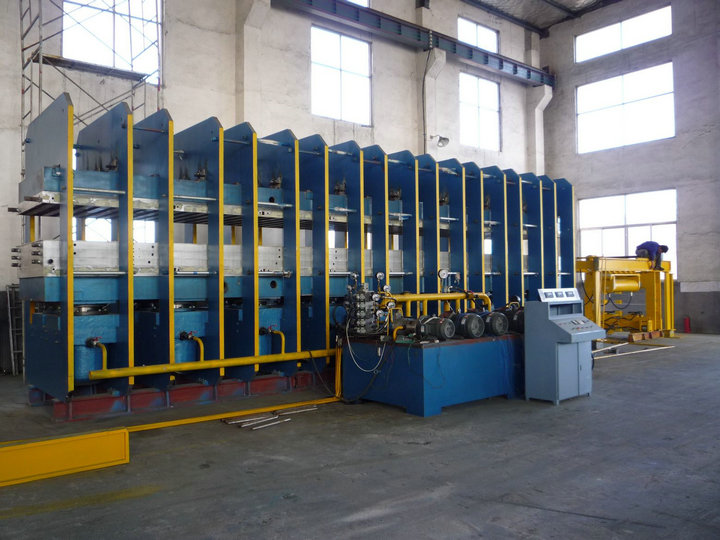
Calendering thickness variation usually stems from roll deflection, inconsistent feed rates, or uneven stock temperature. Traditional compensation involved trimming edges or running slightly thicker gauge, which created a constant stream of scrap. Eliminating scrap starts with abandoning that overcompensation mindset and relying on real-time measurement instead.
Modern calenders can mount non-contact thickness sensors across each roll and feed the data into an automatic nip control system. The system adjusts roll gaps within milliseconds, correcting for any deviation. Uniform roll surface temperature and tightly controlled feed rate further reduce the sources of variation. In many cases, thickness across the full width can be held within a ±0.5% band without any post-calender edge trimming.
Once that consistency level is reached, scrap disappears naturally. The line no longer needs to stop for edge slitting or rejecting off-spec product, and operators can shift from constant adjustment to monitoring overall trends. The result is a repeatable calendering output without the scrap burden.
Cutting and Layup: Where Belt Strength Begins
The strength of a conveyor belt isn't decided by the rubber compound alone—it starts at the cutting table. Every fabric ply, every steel cord, every layer of rubber sits at a specific angle and position. When the cutter's blade follows the bias line, it isn't just slicing material; it's setting the geometry that determines how tension, impact, and flex will travel through the finished belt. A sloppy cut here doesn't show up immediately. It waits until the splice or the first heavy load, then tears along the path of least resistance.
Layup is where those cut pieces become a structure. The operator builds the belt from the inside out, checking ply alignment, overlap, and gauge as each layer goes down. Air trapped between plies isn't a minor flaw—it's a future blister waiting to delaminate under load. Skilled hands adjust tension on the fabric, brush away dust, and press each layer firmly before the next one arrives. This is quiet, deliberate work, the kind that doesn't tolerate shortcuts. The best layup operators read the material with their fingertips, feeling for inconsistencies no gauge can catch.
What leaves the building table is already a belt, even before it enters the press. If the cutting was true and the layup tight and even, the vulcanization simply locks in what was already correct. If not, no amount of heat or pressure can fix a bad carcass. That's why experienced engineers say the press only confirms what the cutter and the layup operator already decided. Belt strength doesn't get added later—it's either present in those early, unglamorous stages, or it never appears.
Press Curing Schedules That Keep Lines Moving
In fast-moving production environments, press curing schedules often become the hidden bottleneck. The goal isn't just hitting a target durometer or crosslink density—it's doing that without letting molds sit idle or operators wait on timers. A practical approach is to segment the cycle into heat-up, dwell, and venting phases, then track actual part temperature rather than relying on a fixed clock. Small adjustments, like preheating inserts or staging mold changes during the dwell window, can shave minutes off each cycle.
Another lever is sequencing multiple presses slightly out of phase. Instead of all stations ending a cure at the same instant, stagger start times so unloading and reloading flow continuously. When cure time must stay fixed for material reasons, look at downstream steps: can trimming, cooling, or inspection happen while the next batch cures? That kind of overlap keeps the line moving without sacrificing the cure integrity.
Camera Inspections That Spot Sub-Millimeter Flaws
High-resolution imaging systems now routinely catch defects that are invisible to the naked eye. By combining precision optics with advanced image processing algorithms, these cameras identify hairline cracks, microscopic pores, and surface irregularities as small as a fraction of a millimeter. Unlike manual checks, the process runs continuously on production lines and flags inconsistencies without slowing throughput.
In fields like electronics assembly, precision machining, and medical device manufacturing, even a tiny flaw can compromise performance or safety. A camera inspection station scans each part under controlled lighting and compares it against a digital reference model. This approach removes the variability of human inspectors and detects subtle deviations in geometry, finish, or material integrity that would otherwise go unnoticed until failure occurs.
Adopting this kind of automated inspection also reduces waste and rework costs. Instead of discarding entire batches due to suspected defects, manufacturers can pinpoint exactly which units fail the criteria and address the root cause faster. Because the method is non-contact and non-destructive, it works for delicate or heat-sensitive components that cannot tolerate traditional probing or testing.
Small-Batch Custom Belts From a High-Speed Line
Most production lines force a trade-off between speed and customization. This one doesn't. Quick-change tooling and automated cutting stations let a run of fifty belts with unique lengths, hole patterns, or buckle slots move through as smoothly as a standard batch.
The high-speed conveyor keeps material flowing while laser markers handle personalization on the fly. Operators swap out dies or load fresh vector files between lots without stopping the line, so short-run orders don't get parked waiting for setup.
Every belt is tracked by barcode from raw hide to final inspection, which nearly eliminates mixed-up specs. You get the consistency of mass production with the flexibility of a small workshop, and your customers get belts that actually match what they asked for.
FAQ
Many facilities have shifted toward fully integrated automation, using real-time monitoring and modular tooling that lets them switch belt specifications without halting the entire line. That flexibility is rare in legacy plants.
Instead of relying on end-of-line sampling, they pull data from extruders, calenders, and curing presses at fixed intervals. Any drift in thickness or tensile strength triggers an automatic adjustment, so the batch stays within tolerance rather than being reworked later.
High-grade synthetic rubber blends and steel cord or fabric reinforcements are sourced with tighter impurity limits. Some plants have on-site labs that test each incoming lot before it reaches the mixing floor, which prevents weak spots from forming during vulcanization.
Custom work is actually a strong point. Lines can be reconfigured for different widths, cover thicknesses, and cord spacing in a matter of hours. It allows clients in mining, ports, and food processing to get belts matched to specific load and abrasion conditions.
Waste heat from curing sections is often captured and fed back into drying or preheating stages. Variable frequency drives on mixers and mills also reduce idle power draw, which lowers overall energy use per meter of belt produced.
Many newer lines use closed-loop cooling water and solvent recovery systems. Trim waste and rejected sections are ground and blended back into lower-layer compounds where performance standards allow, reducing landfill volume significantly.
A well-designed line has buffer zones between each stage, so a brief slowdown in one area doesn't cascade. Combined with predictive maintenance on bearings and gearboxes, plants can run near capacity for extended stretches without unplanned downtime.
Look beyond the price per meter. Ask about their inline testing frequency, the traceability of their rubber compounds, and whether they have experience with the specific troughing angle or impact rating your application requires. Visiting the plant during a live run tells you more than a polished catalog.
Conclusion
Across China's conveyor belt factories, the production line has become a study in precision from the very first step. Raw compound feeding is no longer a guess—operators now track viscosity, temperature, and batch consistency in real time, adjusting formulations before the mixer even stops. That discipline carries into calendering, where automated thickness control keeps the rubber sheet within microns of spec, virtually eliminating scrap that used to pile up from edge-to-center variation. The cutting and layup stage, often overlooked elsewhere, gets equal attention: fabric plies are aligned with laser guidance, and tension is matched to the belt's intended load class, because that is where tensile strength is either locked in or lost.
Downstream, press curing schedules have shifted from fixed timers to adaptive profiles based on compound type and belt thickness, so lines keep moving without under-cure risk. Camera inspection systems now scan every square centimeter at production speed, flagging sub-millimeter flaws like trapped air or misaligned cords before the belt leaves the line. Even the demand for small-batch custom belts hasn't broken the rhythm—modular tooling and quick-change press setups let a high-speed line switch between a 500-meter standard run and a 30-meter specialty order in the same shift. The result is a manufacturing model where quality is engineered into each stage rather than sorted out at the end.
Contact Us
Contact Person: Chen Zhengwei
Email: [email protected]
Tel/WhatsApp: +86-13963975727
Website: https://www.sfcrubbermachine.com