

Carousel Rotomolding Machine Maker Selection Tips for Consistent Multi Arm Production
2026-11-18
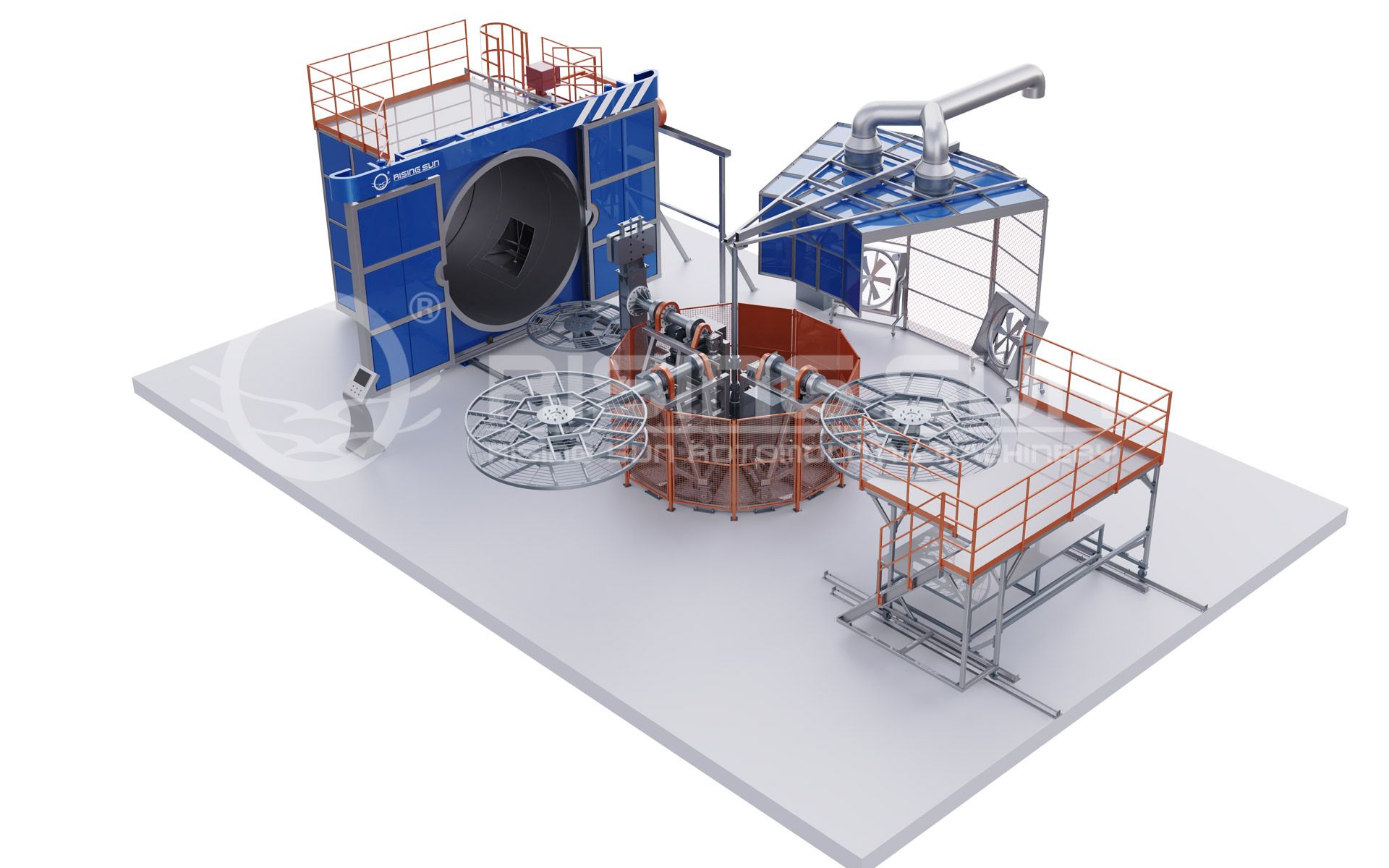
Ask any production manager about multi-arm carousel rotomolding and they’ll tell you the same thing: the arms rarely behave identically. Slight differences in heat, cooling, or mold mounting show up as scrap before anyone catches the root cause. So when it’s time to choose a machine maker, the conversation shouldn’t start with arm count or platen size—it should start with who actually understands that variability. Rising Sun has built a reputation around this exact problem, but even experienced buyers can miss a few make-or-break details. This guide lays out the selection tips that matter for consistent multi-arm output.
What Actually Keeps Every Arm on the Same Cycle
Most people assume the brain sends a perfectly timed signal to each limb, like a conductor waving at separate sections of an orchestra. But the reality is messier and more interesting. Your arms don't stay coordinated because of a single master clock; they stay coordinated because the nervous system constantly compares feedback from both sides and corrects drift before it becomes noticeable. Small timing errors happen all the time, yet the body patches them so quickly that the motion feels seamless.
A big part of this comes from crossed connections in the spinal cord and brainstem, where signals from the left side directly influence the right. When one arm swings forward, it doesn't just report its own position—it also nudges the opposite side to match rhythm and force. If you walk with a heavy bag in one hand, within a few steps the free arm adjusts its amplitude automatically. That's not a conscious choice; it's the product of interlimb coupling that has been shaped by millions of years of quadrupedal movement.
There's also a mechanical factor nobody talks about: the trunk. Both arms hang from the same ribcage and shoulder girdle, so every arm swing creates a tiny rotational force through the torso. This shared physical base acts like a spring linking the two sides. When one arm lags, the torsion through the core changes, and those subtle stretch signals feed back into the stepping pattern. The cycle stays locked not because of perfect timing, but because the body is constantly falling into sync and correcting the fall.
Oven Profiling Details Most Buyers Overlook
Many buyers fixate on cubic feet and forget that usable oven space depends heavily on rack guidance, side wall contours, and how far the door protrudes into the cavity when closed. A model can advertise 5.0 cubic feet yet feel cramped because the lower rack sits too close to the broil element or the curved back wall pushes large baking sheets away from the center. Measuring the actual distance between rack positions, especially for a half-sheet pan with handles, reveals more than the capacity rating ever will.
Another overlooked area is temperature distribution across the cavity. The location of the convection fan, whether it cycles air evenly behind a full baffle, and whether the bottom element stays active during convection baking all change how food browns. Some ovens run noticeably hotter in the back corners or recover slowly after you open the door, which matters more for pastry and multiple tray cooking than a single casserole. Checking how the door vents moisture, where the oven light casts shadows, and whether the gasket seals tightly can tell you a lot about long-term consistency.
Finally, the physical details around installation and daily use get skipped too often. A large glass door may look sleek but can reduce usable viewing angle if the control panel sits too low or the handle placement forces an awkward grip. Oven feet leveling range, the depth of the side gaps for under-counter mounting, and if the door opens without hitting adjacent drawers are small points that become daily annoyances. Buyers who check these details before buying usually end up with an oven that fits their cooking rhythm rather than just the spec sheet.
Questions to Ask Before You Trust a Maker’s Cycle Time
A quoted cycle time rarely means much until you know what it includes. Ask whether the number covers only active machining or assembly, or whether setup, inspection, queue time, and routine tool changes are baked in. If the maker cannot walk you through exactly which operations are counted and which are left out, treat the figure as a rough estimate rather than a planning input.
It also helps to ask how the data was collected and over what period. A figure pulled from a one-off prototype run behaves very differently from one tracked across months of production, with normal operator changes, material variation, and equipment downtime included. Request the sample size, the date range, and whether outliers were removed. If out-of-control points were dropped without explanation, the remaining average may be flattering but fragile.
Finally, ask whether the cycle time holds for your specific part family, batch size, and tolerance requirements. A maker may quote a fast time for simple, repeat work while your job involves frequent changeovers or tight inspection steps. The goal is not to challenge the number for its own sake, but to understand the conditions under which it can actually be repeated.
Where Multi-Arm Consistency Shows Up in Real Parts
Multi-arm consistency leaves its fingerprints in oddly specific places. On injection-molded housings, for instance, one cavity may fill slightly faster than its neighbors, so the same nominal part can show a faint blush near the gate or a minor shift in sink marks across a production run. It is rarely dramatic enough to flag on a single piece, but side-by-side comparison under low-angle light makes the variation obvious.
In machined or welded assemblies, the telltale signs often appear at matched features. Two bores produced by separate spindles may still pass individual checks while their center-to-center distance drifts, or a pair of spot welds made by adjacent arms may show different indentation depth and heat ring size. Those mismatches matter because they change how loads travel through the finished part.
Practical consistency is less about making every arm identical and more about keeping each arm's behavior stable and predictable. When parts are sorted by cavity number or spindle position, subtle trends in wall thickness, torque response, or surface finish become easier to trace. That kind of traceability turns a vague quality complaint into a specific adjustment on one arm.
Service and Wear Support That Prevents Drift
Most drift never shows up as a sudden fault. It builds quietly through worn seals, slight bearing play, and sensor baseline shifts until readings no longer match reality. Our support team treats those early signs as maintenance cues rather than waiting for a failure. We check the hardware at the points where wear actually accumulates, then adjust or replace components before the error becomes embedded in your process.
Service visits are built around reference checks and repeatable measurements, not just visual inspection. Technicians compare current output against known reference values and record the smallest offsets. That record becomes a trend line, so a developing problem is visible long before it affects production. When a part is nearing the end of its useful life, we flag it and schedule the replacement around your downtime.
The result is less time correcting data and more time trusting it. Preventing drift is not a one-off calibration; it is a steady rhythm of observation, replacement, and verification. Over repeat visits, that rhythm keeps instruments within the tolerance bands your work depends on.
Sizing the Carousel for Your Daily Changeover Reality
A carousel that looks perfect during a demo can fall apart by Tuesday afternoon. The real question is not how many products you want to show, but how many you can actually rotate before the team loses track of what went live. Start by mapping the smallest meaningful set: the items that need to change every day, the ones that shift twice a week, and the evergreen pieces that anchor the space. This rough rhythm tells you the upper limit of the carousel before it becomes a burden.
Most teams overestimate their refresh capacity. If the daily changeover window is fifteen minutes between closing and reopening, a six-slide carousel with custom graphics and layered messaging simply won't survive the week. Instead, set the carousel length based on the most constrained day, not the average. A good rule of thumb is to leave one empty slot that can be filled with a temporary note, a broken item removal, or a quick seasonal swap without redesigning the whole set.
Shorter carousels with clear rotation rules outperform larger ones that drift into repetition. Two or three actively managed slots create a sense of movement, while a long line of static slides teaches customers to ignore the feature entirely. Match the carousel size to the reality of who is changing it, when they have time, and what they can realistically keep accurate under pressure.
FAQ
Start with how the builder handles arm indexing repeatability. A machine that drifts a few degrees over time will create uneven wall thickness and thermal imbalance across stations. Ask for real data from past installations, not just catalog claims.
More arms shorten cycle gaps but also multiply the places where timing, gas pressure, and cooling can fall out of sync. The frame must be rigid enough to keep every arm moving through the same path without flex, and the controls need individual arm compensation rather than one shared setting.
Look for even heat distribution across the full swing diameter, with multiple zones that can be tuned independently. Forced air that only hits the outer edge of the mold will leave inner sections thinner. A good maker will show temperature mapping results for the full arm radius.
Recipe management tied to mold ID, automatic flame or air adjustment per arm, and data logging of chamber temperatures and cycle times. Without logged variables, operators end up chasing drift manually after hundreds of cycles.
Cooling rate directly affects shrinkage, warpage, and cycle time. Multi-arm carousels can have uneven residual heat if cooling stations are undersized or airflow is not isolated. Check whether the maker specifies cooling capacity per station rather than one total figure.
Ask for installation support, on-site tuning for your specific molds, and a clear spare parts list with lead times. A builder that cannot tell you the expected life of bearings, seals, or gas lines under your intended cycle rate is not prepared for continuous multi-arm output.
Provide the full mold envelope, weight, and swing clearance requirements, then ask the maker to calculate load per arm and station dwell capacity. The answer should include center bearing load ratings, arm deflection limits, and drive torque margin, not just a general tonnage number.
Conclusion
Most buyers treat cycle time as a single number, but consistent multi-arm production starts earlier than that. What keeps every arm on the same cycle is not just a synchronized timer; it is the oven’s ability to deliver repeatable heat to each mold as it passes through the same zones. Oven profiling details get overlooked constantly, including recovery rate after doors open, air movement across the top and bottom of the mold, and whether temperature sensors reflect real part surface conditions rather than oven air alone. Before trusting a maker’s cycle time, ask how that figure was measured: with what mold mass, under what ambient temperature, at what gas pressure, and with how much cooling dwell. If those variables are not written down, the quoted cycle time is more of a sales estimate than a production plan.
Consistency shows up later in real parts as wall thickness variation, warpage, or insert and thread stability, and those flaws often trace back to uneven arm speed, mold mounting, or oven airflow rather than resin quality. Service and wear support matters because trunnion play, chain stretch, guide roller wear, and burner drift gradually move arms out of alignment and change heat exposure. A maker that supplies wear inspection points and adjustment procedures gives you a way to catch that drift before scrap appears. Finally, size the carousel around your actual changeover rhythm, not just the largest mold diameter. Count how many different molds you run in a day, how much time you need for loading and stripping, and whether unbalanced arm loading will restrict usable stations. That daily operating pattern should drive the number of arms, station spacing, and work platforms more than any catalog capacity chart.
Contact Us
Contact Person: Sharon Zhu
Email: [email protected]
Tel/WhatsApp: 8615712666272
Website: https://www.risingsunroto.com