

Boron Carbide Tiles Manufacturer Key Factors for Durable Ceramic Armor
2026-10-23
When a projectile slams into a ceramic armor plate, the difference between survival and catastrophe often comes down to a few critical details in the boron carbide tile itself—density, grain uniformity, and how well the manufacturer controls the sintering process. Yet not all tiles are created equal, and choosing the right supplier can feel like navigating a minefield. That’s where HUAYI TECH enters the picture. With years of focused expertise in advanced ceramics, HUAYI TECH has honed the key factors that turn raw boron carbide powder into durable, battle-ready armor. Here’s what separates a truly resilient tile from one that fails under stress—and why manufacturing precision matters more than most buyers realize.
Raw Powder Purity: The Invisible Ceiling for Tile Hardness
Every ceramic tile inherits its maximum achievable hardness long before it enters the kiln. The raw powder's purity sets a boundary that no amount of firing precision or grinding finesse can cross. Trace amounts of sodium, calcium, or iron—often below 0.1% by weight—migrate to grain boundaries during sintering. There they form low-melting glassy films that interrupt the crystalline lattice. The result is a tile that measures hard on the surface but fails under Vickers indentation because cracks propagate along those impurity-rich interfaces. This is the invisible ceiling: a structural limit imposed not by process variables, but by the chemical cleanliness of the starting material.
Take alumina-based wear tiles as a concrete case. A 99.5% pure alumina powder may deliver a Vickers hardness around 12 GPa. Push the purity to 99.99% and the same sintering schedule yields 17–18 GPa. The difference is not in density—both can reach 99% of theoretical—but in what sits between the grains. Impurities such as silica or magnesia act as sintering aids, yet they simultaneously create secondary phases that soften at room temperature or under load. In high-hardness applications, that softening becomes the weak link. No post-processing can remove these phases once they have formed. Thus, the ceiling is fixed at the powder stage, and every downstream step merely reveals how close to that ceiling the final tile can get.
This is why leading manufacturers increasingly treat raw powder purification as a hardness parameter in its own right. They chemically assay incoming batches not just for average particle size or phase composition, but for the part-per-million levels of alkali and transition metals. Because once a tile's hardness requirement exceeds what its powder purity allows, the only real solution is to change the powder—not to adjust the press or extend the firing curve. The invisible ceiling cannot be raised from below; it must be moved by purifying the raw material itself.
Hot Press Profiles: How Heating Curves Shape Crack Resistance
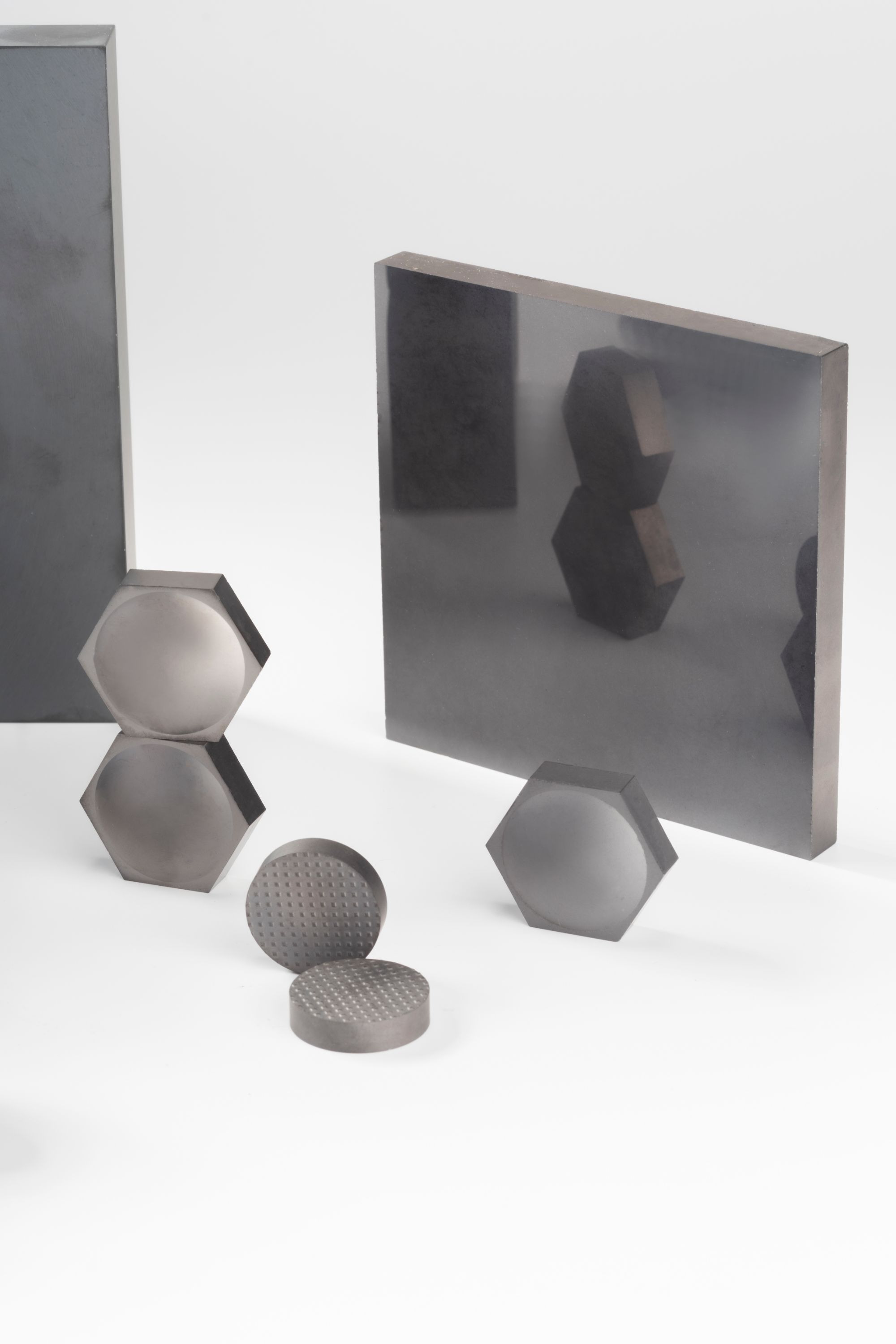
Hot press operations rarely reward a single fixed temperature. The way heat enters a laminate, climbs through the press cycle, and tapers off determines how internal stress gets distributed. A steep early ramp may speed up the schedule, but it can trap volatiles and leave the panel's core lagging behind the surface. That mismatch often shows up later as microcracks near resin-rich zones.
Dwell timing matters just as much as peak temperature. If the curve levels off too briefly, the adhesive or resin might not reach full flow, so bonding stays incomplete at the centre. A longer, gentler hold allows pressure and temperature to equalise across the profile, reducing locked-in strain. Adjusting the curve by only a few degrees per minute can shift failure modes from brittle edge cracking to ductile deformation.
Cooling is another part of the same story. Dropping temperature too fast after pressing can set up thermal gradients that pull the surface into tension. Controlled cooling, often with staged steps below the glass transition, gives the material time to relax and settle. In practice, the best crack resistance comes from a balanced curve: enough early heat to mobilise the binder, enough dwell to consolidate the core, and enough tail cooling to avoid residual stress.
Flatness, Chamfers, and Fit: Geometry Details That Stop Penetration
Surface flatness rarely gets the attention it deserves until a sealed joint starts weeping. Even a few microns of deviation across a flange face create a labyrinth of tiny channels that liquids or gases can follow. Controlling flatness isn't just about hitting a number on a drawing; it's about understanding how the mating surfaces deform under clamping load. A lapped or precision-ground face distributes pressure evenly, collapsing microscopic voids and forcing the seal to work as intended. Ignore this, and you'll find yourself chasing leaks that no amount of torque can fix.
Chamfers are often dismissed as edge breaks, but they play a decisive role in stopping penetration. A sharp corner concentrates stress, inviting cracks that propagate into leak paths, while a well-placed chamfer relieves that stress and guides the mating part into alignment. The angle and depth matter more than they appear: too shallow and the edge still bites; too steep and you sacrifice contact area. In dynamic assemblies, chamfers also prevent scoring during insertion, which is critical when repeated assembly and disassembly must not compromise the sealing interface.
Fit is the third leg of the stool, and it ties flatness and chamfers together. An interference fit can physically block a fluid path, but only if the mating surfaces are smooth and the entry geometry is forgiving. A slight taper or a controlled press fit forces material into contact across the entire circumference, eliminating the gaps that allow capillary action. The trick is balancing the interference so you don't gall the surfaces or make disassembly a destructive event. When flatness, chamfer design, and fit tolerance all point the same direction, you get a joint that holds back pressure without relying on excessive sealant or brute force.
Backing Bond Strength: The Layer That Keeps Ceramic from Shattering
A ceramic plate dropped onto tile often survives the fall, yet shatters when struck by a spoon. The difference rarely comes down to the clay or glaze alone, but to the hidden layer that binds them: the backing bond. This thin interface forms where glaze meets body, and its strength decides whether a crack stays superficial or tears through the entire piece.
During firing, the glaze and clay expand and contract at different rates. If the bond between them is weak, micro-fractures start at the surface and race inward with almost no resistance. A strong backing bond, however, acts like a flexible seam, absorbing stress and keeping fractures from linking up. Potters often test this by tapping a finished piece and listening for a dull thud rather than a clean ring.
The chemistry here is subtle. Small shifts in silica-to-alumina ratios in the glaze, or a slightly longer soak at peak temperature, can double the interfacial strength without changing the look of the piece. That is why two cups with identical recipes can behave completely differently on a kitchen floor. The real armor is not the shiny surface, but the handful of microns where two materials stop being separate and start working as one.
Ultrasonic and Ballistic Batch Checks: No Tile Leaves Without Proof
The line doesn't run on trust. Each fired tile passes under a bank of ultrasonic transducers that ping through the body and listen for echoes. A dense, clean return means no hidden voids or hairline fractures—anything else trips a red light, and the tile is diverted off the belt before it can reach the packing station.
For impact resistance, we don't just rely on lab reports. Random samples get pulled from the same kiln batch and hit with a calibrated projectile at a set velocity. The damage pattern—or lack of it—gets photographed and logged against the batch code. If a single sample underperforms, that batch stops moving until every tile in it is re-screened or pulled.
Only when both the ultrasonic scan and the ballistic log show a clean pass does the batch get its release signature. No signature, no pallet wrap, no truck. That's how a tile earns its way out the door.
From Mine Lot to Final Tile: Traceability That Reduces Field Risk
When a shipment leaves the quarry, that's where the real test begins. We don't just slap a barcode on a crate and call it done. Every lot gets a unique identifier that travels with it through cutting, finishing, and packing. This means if a batch of stone shows unusual veining or a subtle color shift, we can trace it back to the exact block it came from within hours, not weeks.
On-site, that traceability turns into confidence. Installers can pull up the lot history before a single tile goes down, checking for consistency in shade and calibration. If a problem does surface mid-installation, we're not guessing which pallets might be affected. The system pinpoints the affected range, so you only quarantine what's truly suspect instead of shutting down the whole job.
Field risk drops because surprises get caught early. A contractor doesn't have to gamble on whether two shipments will match. The data travels ahead of the material, giving project managers a clear view of what's arriving and how it relates to what's already on the wall or floor. Less guesswork, fewer returns, and a smoother handoff from quarry to finished space.
FAQ
It comes down to density and hardness. Boron carbide sits around 2.5 g/cm³ while alumina is closer to 3.9 g/cm³, so for the same areal density you get a thicker tile and better multi-hit protection without adding more weight. Its Vickers hardness can exceed 30 GPa, which helps shatter incoming penetrators more efficiently.
Pressureless sintering often leaves residual porosity that acts as crack initiation sites. Hot pressing, especially with small amounts of carbon or silicon carbide as sintering aids, limits grain growth and closes pores. That yields a finer microstructure and more consistent hardness across the tile, which translates into tighter shot-to-shot performance.
Thicker tiles obviously stop more energy, but the real issue is how stress waves reflect from the free surfaces. A poorly radiused edge or an abrupt change in cross-section can create localized tensile zones where cracks start. Curved tiles need uniform compaction during pressing; otherwise density gradients create soft spots that fail early.
Look for ultrasonic C-scan mapping of every tile, not just batch testing. Density checks by Archimedes method, microstructure evaluation via SEM, and ballistic testing per NIJ 0101.06 or VPAM standards on the actual tile geometry are all reasonable. Also ask about batch-to-batch hardness variation; anything above ±1 GPa should raise a flag.
Sharp, chipped edges concentrate stress and let moisture penetrate the tile, which can weaken the bond with the backing. A slight chamfer or radius on the edges and a smooth, clean bonding surface improve adhesive wetting and reduce cracking during handling and temperature cycles.
These additions usually address specific failure modes. A thin SiC layer can suppress boron carbide's tendency to undergo localized amorphization under high pressure, which sometimes leads to premature loss of strength. A polymer wrap or coating keeps fragments contained after a hit and protects the tile from environmental degradation before it is installed.
Many people assume harder is always better. However, ultra-hard tiles that are too brittle can shatter over a large area after a single impact, compromising multi-hit capability. A balanced combination of hardness, fracture toughness, and controlled grain size typically outlasts a simply harder but less tough tile in real use.
Beyond price, verify whether the manufacturer controls the raw powder purity and particle size distribution in-house. Ask for lot-by-lot ballistic certificates rather than a single prototype test. Also check if they can support custom geometries without outsourcing the hot pressing, because that usually indicates better process control and faster feedback loops.
Conclusion
Manufacturing boron carbide tiles that hold up under repeated impact starts with raw powder purity. Even minor metallic or oxide contamination can cap hardness well below the theoretical limit, so suppliers who verify each incoming lot with techniques like X-ray fluorescence or wet chemistry end up producing armor that resists microcracking before it ever reaches the press. The hot pressing profile matters just as much: a heating curve that rises too quickly leaves residual stress and uneven grain growth, while a controlled ramp with staged dwells improves crack deflection. On top of that, flatness, chamfer angles, and edge fit are not cosmetic. A tile that sits slightly proud or has a sharp chamfer can create a stress riser that lets a threat focus energy into one point, defeating the ceramic before the backing even engages.
The bond between tile and backing is another quiet failure point. If the adhesive layer is too brittle or applied unevenly, the ceramic shatters on first hit instead of transferring load across the whole panel. Batch-level ultrasonic scans catch internal voids and delamination, and periodic ballistic testing against specified threats confirms that the production line hasn't drifted. None of this matters without traceability: tracking every tile back to its powder lot and pressing cycle lets manufacturers isolate a bad batch and pull it from field use before it becomes a casualty statistic. Together, these factors separate durable ceramic armor from plates that merely meet a datasheet.
Contact Us
Contact Person: Junting Leo
Email: [email protected]
Tel/WhatsApp: +86 18615009766
Website: https://www.huayimaterial-china.com/